
Adaptive Automate, Shopify Store Build
A full Shopify store build for Adaptive Automate, an independent retailer of Miccell tech accessories: Bluetooth party speakers, wireless earbuds, car chargers, mounts, and charging cables. Custom theme, multi-collection structure, and...
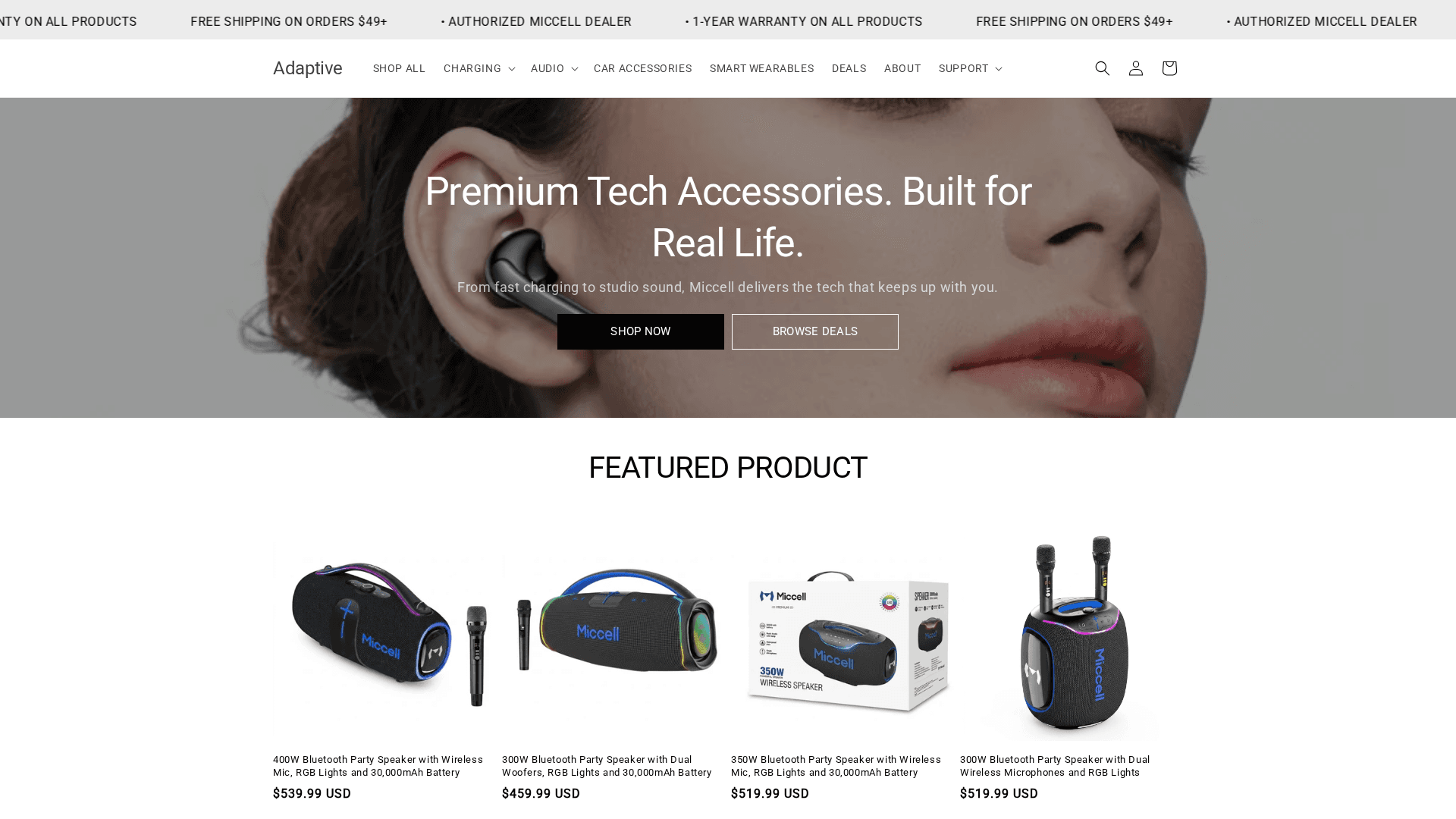
A full Shopify store build for Adaptive Automate, an authorised Miccell dealer selling phone and audio accessories: Bluetooth party speakers, wireless earbuds, car chargers, mounts and charging cables.
Custom theme, multi-collection structure, conversion-focused merchandising.
What was in the way
Consumer tech accessories is a trust-poor category online.
The products are unbranded to most buyers. Price points are low enough that nobody researches hard. And the default assumption, earned by years of bad experiences, is that the store might be a dropshipper who disappears after checkout.
A shopper who is unsure does not email to ask. They close the tab and buy the same item from a marketplace they already trust, at a worse price, because the marketplace is not the risk.
So the build is a credibility problem before it is a design problem.
Five parts, each with a reason
A restrained tech-brand theme
Clean and conventional, deliberately. In this category looking legitimate beats looking creative. An unusual layout reads as amateur rather than distinctive, and every deviation from what a shopper expects costs a little confidence.
Collections organised by intent
Portable speakers, earbuds, party speakers, car accessories and charging.
A shopper in accessories usually knows what they want before arriving. The structure gets them there in one click rather than making them browse a single flat catalogue.
Real customer reviews
Social proof from actual buyers. In a category full of anonymous listings this is the strongest available signal, and it is the one a marketplace competitor also has, so its absence is conspicuous.
Shortened checkout path
Product pages carry a quantity selector with both add to cart and buy now, so an impulse purchase does not detour through the cart.
Accessories are an impulse category. Every step between intent and payment loses a percentage, and the cart page contributes nothing when the order is one item.
Trust badges placed where doubt happens
Free US shipping, price match, 30 day returns, and the customer count, positioned near the buying decision rather than in the footer.
Footer trust badges are decoration. The moment doubt actually occurs is at the add to cart, and that is where the answers belong.
The engineering underneath
Shopify with custom Liquid theme work rather than an app-assembled store.
The decision that matters here is app restraint. It is easy to solve every requirement in this category with an app: reviews app, trust badge app, upsell app, sticky cart app. Each adds script weight to a store whose audience is largely on mobile, and each adds a monthly cost to a business selling low margin accessories.
Where an app genuinely earns its place, reviews being the clear case, it stays. Where the requirement is presentational, it is built into the theme.
Collection and product templates are structured so new product lines drop in without template work, which matters for a dealer whose catalogue follows a supplier's range.
Shopify with custom Liquid theme customisation. Built for an everyday tech audience shipping within the United States.
See it live
Adaptive Automate, Shopify Store BuildThe live site · adaptiveautomate.comHire me for this
Shopify Store Management & VAFrom $10/hrAmazon & Ecommerce VAFrom $10/hrProjects like this
Awareness Avenue, Customizer
Six Shopify Liquid product customizers for personalised jewellery, including the ring pair that replaced a...
DECKO Referrals and Affiliate Page
An affiliate recruitment landing page for DECKO Australia, powered by UpPromote. Affiliates earn 7% commission...
Synful Novelties, Shopify Store Build
A full Shopify store design and build for Synful Novelties, a lingerie and intimates brand. Editorial,...
I build software, and I measure whether it works.
The same questions I research are the ones I ask on client builds: is it reliable, is it fast, is it easy to use, and is it secure. Those four drove satisfaction in my ICT portal study, and they shape how I scope and test every project.