
DECKO VIP Cashback Program Page, Shopify (AU)
An invitation-only cashback referral landing page for DECKO's VIP clients. Referred friends save 5% on their first order, the referrer earns 10% cashback on every order they drive, integrated with the Bixgrow referral platform.
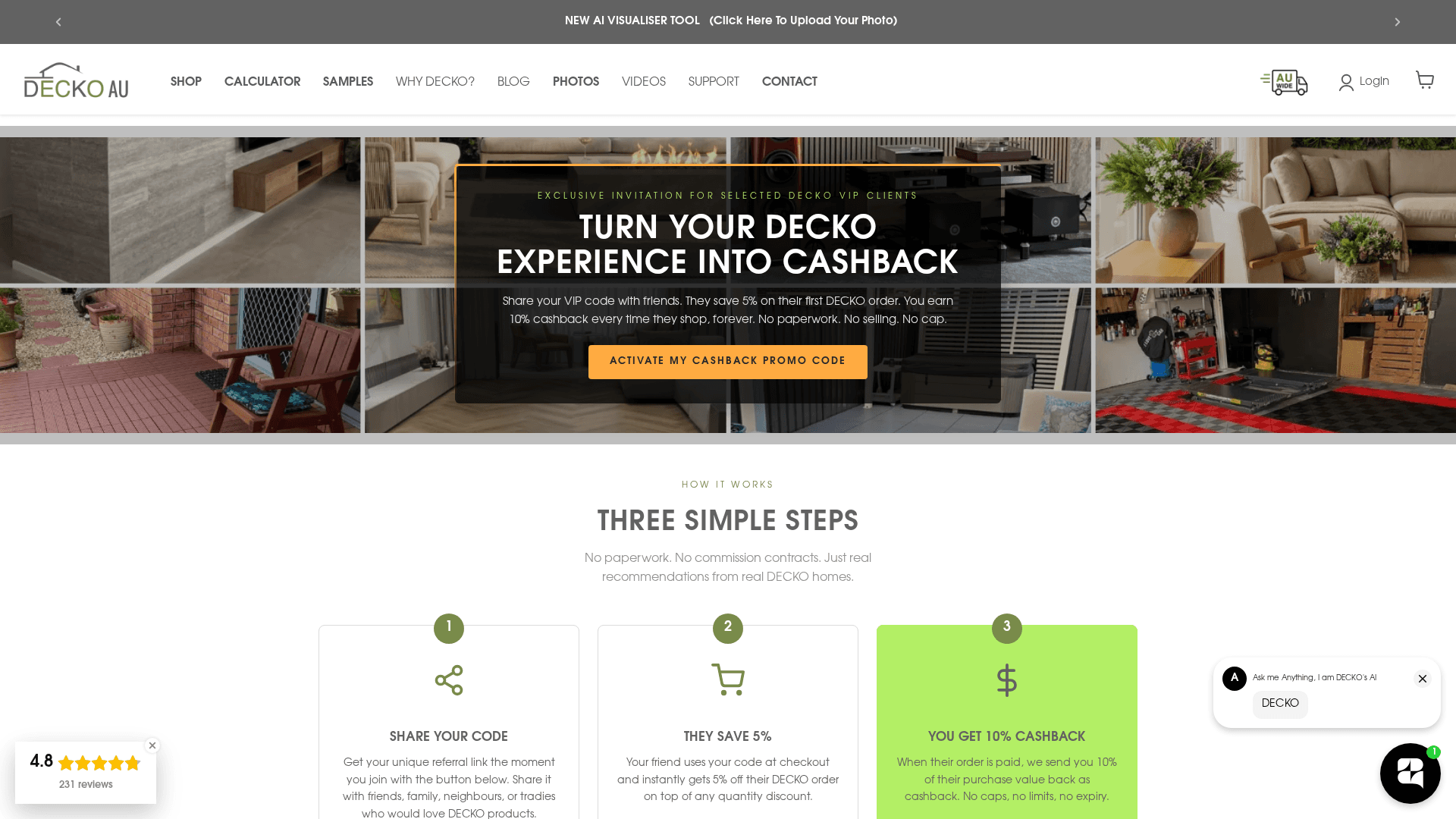
An invitation-only cashback referral page for DECKO VIP customers. Referred friends save 5 percent on a first order, the referrer earns 10 percent cashback on every order they drive.
Gated to past customers who spent AU$500 or more, integrated with Bixgrow.
What was in the way
Referral programs fail on arithmetic.
People will not share a code if they cannot immediately work out what they get. Vague promises of rewards convert nobody, and a program that requires the customer to do sums loses them at the sum.
An open cashback program pays out on orders that would have happened anyway. Gating it to customers who have already spent AU$500 means the reward goes to people with genuine reach into the same buyer group: renovators, tradespeople and repeat DIY customers who talk to other renovators.
It also changes the tone. An open program is a discount scheme. An invitation to past customers is a recognition, and people share things that flatter them more readily than things that pay them.
There is a second problem specific to a gated program. The visitor has to understand both that they qualify and what qualifying is worth, in the same breath, or the gate reads as an obstacle rather than a privilege.
Four parts, each with a reason
Three step flow, stated in one line
Share your code, your friend saves 5 percent, you earn 10 percent cashback.
Both sides of the exchange visible at once. A referral program is a request to spend social capital, and the visitor is deciding whether the return justifies it.
Bixgrow integration
Users are routed into the referral platform to activate their unique code, with the storefront messaging carrying them to the handoff.
Bixgrow handles code generation, attribution and payout tracking. The page handles persuasion and the handoff.
Live earnings table with worked examples
Actual numbers against actual order values.
This is the core of the page. DECKO order values are high, so 10 percent cashback on a single referred order is a meaningful figure, and showing it against a realistic order removes the need for the visitor to calculate anything.
FAQ covering the awkward questions
Payout method, caps, whether it stacks with quantity discounts, how returns are handled, and the trial period.
These are the objections that quietly kill signups when they go unanswered. The stacking question in particular: a VIP customer already gets volume pricing and wants to know whether cashback is additional or instead.
The engineering underneath
Custom Shopify page in Liquid and JavaScript, connecting storefront messaging to an external referral engine.
The gating is presentational rather than enforced at the page. The page is not secret, it is targeted, and qualification is applied by Bixgrow when a code is activated. Building a hard gate would have meant customer accounts, a login wall and a support burden, for a program whose whole point is low friction.
The earnings table is static content rather than a live calculator, deliberately. The referrer needs one clear worked example, not a tool. A calculator here would add interaction to a decision that is already simple.
Shopify with custom Liquid and JavaScript. Bixgrow for referral code generation, attribution and cashback tracking.
The AU$500 threshold is low enough that a meaningful number of past customers qualify, and high enough that it excludes single-item sample orders.
Three places, none of them the landing page.
Payout mechanics that nobody explained, so the referrer never learns whether they were paid and stops referring.
Attribution that fails silently when a referred customer browses on mobile and buys on desktop, which in surfaces is the normal pattern rather than the exception.
Stacking rules left undefined, so a VIP customer applies their referral on top of volume pricing, the order is flagged, and somebody has an awkward conversation.
All three are configuration and copy problems rather than design problems, which is why the FAQ carries as much weight here as the offer.
Hire me for this
Shopify Store Management & VAFrom $10/hrAPI & IntegrationsFrom $14/hrAmazon & Ecommerce VAFrom $10/hrProjects like this
Awareness Avenue, Customizer
Six Shopify Liquid product customizers for personalised jewellery, including the ring pair that replaced a...
DECKO Referrals and Affiliate Page
An affiliate recruitment landing page for DECKO Australia, powered by UpPromote. Affiliates earn 7% commission...
Adaptive Automate, Shopify Store Build
A full Shopify store build for Adaptive Automate, an independent retailer of Miccell tech accessories:...
I build software, and I measure whether it works.
The same questions I research are the ones I ask on client builds: is it reliable, is it fast, is it easy to use, and is it secure. Those four drove satisfaction in my ICT portal study, and they shape how I scope and test every project.